
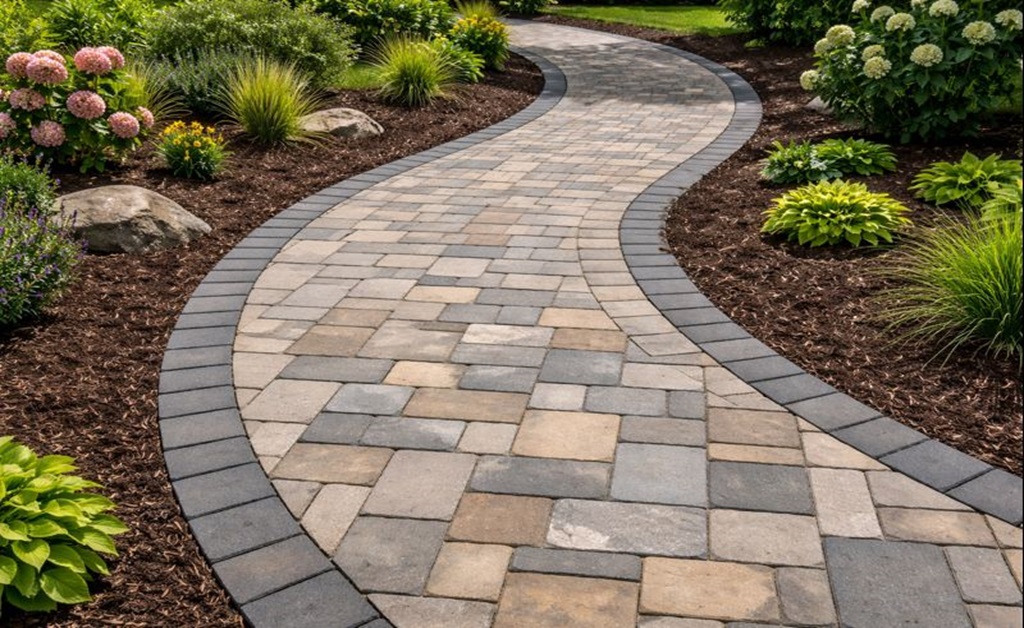
There is an undeniable sense of welcome in a nicely laid walkway leading up to a residence. Installing a walkway creates a sense of unity in a residence in terms of both aesthetics and functionality. When homeowners work with a contractor such as ourselves to install walkways in their residences, walkways paved using paving stones come up frequently because they are readily versatile and aesthetically pleasing.
While a walkway paved using paving stones can make a residence aesthetically appealing when put in place, most homeowners forget that paving stones can make a residence both aesthetically and functionally appealing in a manner not immediately apparent to homeowners. For those interested in enhancing color or visual texture, many choose to use a concrete stain in OKC for a unique and lasting finish.
The Challenges of Achieving Durability
The main nemesis of every outdoor hardscaping project is earth itself. Earth is in a constant state of motion, shifting, and settling, depending on levels of moisture and temperatures. Sadly, it is not uncommon to see a do-it-yourself walkway project come crashing apart in a matter of a few years. This is not uncommon because, without a doubt, Mother Nature can make short work of a beautifully laid walkway in a matter of years.
Earth undergoes natural expansion and contraction with shifts in temperatures, which can prove disastrous for walkways. Water runoff is another challenge in creating walkways. For those unsure about how to lay paving stones for a walkway, understanding the impact of these natural elements is crucial before beginning any installation.
Techniques Adopted by Professionals for Durability
In a paving stones for a walkway installation, our attention is basically on the prep work. To begin with, we excavate the area much deeper than how high the paving stones will be. Generally, for a walkway path, we excavate six to eight inches deep to remove organic topsoil, which can easily shift. Following excavation, if need be, a geotextile fabric can be laid in order to keep the existing soil from getting mixed with a new base material.
The next most important step is to lay a granular base. Here, we spread crushed aggregate materials, sometimes called road base, and compact it well. We do not compact it all at one time because if we do, the bottom part will be loose. To achieve this, we compact it in lifts, or layers, to achieve maximum compactness.
Once this base is solid rock, we spread a one-inch thick bedding of sand on top. Here, a smooth surface is obtained where these pavers can be placed. Once they are laid in a decorative manner, we install edge restraints to prevent the pavers from shifting towards one side. Lastly, we sweep a bag of polymeric sand in between these stones, which will harden when soaked with water to keep these stones in place and prevent any weeds from growing in between.
Concrete Contractors Are the Secret
Although this might seem rather simple in theory, in practice this work calls for specialized equipment and expertise, which most homeowners do not have. As a team of concrete specialists, we at Bill’s Custom Concrete have access to heavy plate compactors and laser levels which allow for an accuracy level beyond the capabilities of those working with manual tools. Furthermore, our familiarity with local soil composition and drainage patterns gives us an edge over all other walkway companies, which enables each homeowner to have their walkway prep work specially designed based on their individual grounds.
Enjoying Your New Durable Paving Stone Walkway
A properly constructed walkway adds value to your home, as well as increasing your personal satisfaction. With a focus on solid construction from the very first removal of earth, you can be assured your walkway will be level, safe, and aesthetically pleasing from season to season. If you’re looking for paving ideas for walkways, our professional construction service can help inspire and execute the perfect design. With our expertise, you can step out your front door with confidence, knowing your foundational surface is sound!