
Your driveway is your primary entrance that gets constant exposure to car traffic and weather elements. There are a lot of people who tend to invest all their efforts into stamping patterns, creating various textures or decorative edges, but completely forget about a key detail of the process – concrete slab depth.
For concrete driveways in Oklahoma City, concrete slab thickness will determine whether it can serve you for decades, whether it will survive constant weight impact and extreme weather changes. Pouring concrete slab too thin would inevitably result in its cracking and crumbling over time. Meanwhile, an overly thick slab is a waste of money. Let us help you calculate how deep the concrete should be at Bill’s Custom Concrete & Yard Drainage!
Determining the Depth of Your Driveway Slab
The Weight of Cars Parked on It
The primary detail influencing the thickness of your driveway is obviously the amount of physical load that the surface will have to withstand every day. How thick should a concrete driveway be? Light passenger cars and small commuter trucks do not present any threat here, but heavy-duty pick-up trucks, large recreational vehicles, or frequent deliveries are more difficult tasks to deal with. Our team usually asks the customer what is the heaviest vehicle that they are going to park there.
The Condition of Subgrade Soil
Concrete slabs completely rely on the subgrade soil. If your soil is soft, wet, unstable or not graded properly, even the thickest pour of the concrete is likely to start cracking sooner or later. If you are asking how thick should concrete be for a driveway, stable soil that is compacted enough allows pouring a standard slab with regular thickness. Meanwhile, for expansive clay soil or soil with poor drainage properties, a thicker pour and more complex base preparation would be needed.
Impact of Weather Conditions and Freeze-Thaw Cycles
Weather changes play a crucial role in how durable and long-lasting your surface is. In colder climates, where freeze-thaw cycles are common, water trapped inside the soil freezes and causes expansion and movement. Such movements will easily crack a thin or poorly constructed driveway surface. Proper driveway concrete thickness, a thicker pour, and properly planned expansion joints will resist these natural forces successfully.
Advice of Professional Custom Concrete Contractors
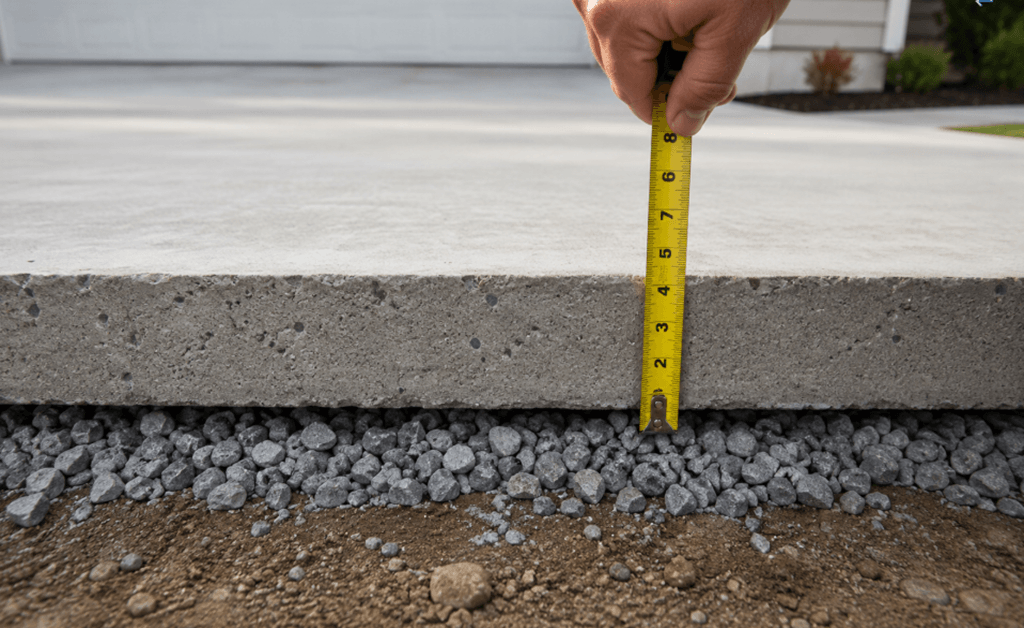
For a residential driveway intended to hold regular vehicles, the standard thickness of a concrete slab is four inches. Such a thickness is sufficient for a slab placed on a properly graded and compacted gravel subbase, capable of holding typical cars or small mid-sized SUVs.
However, we suggest making your slab thicker, namely five inches thick. Just one additional inch of concrete will provide fifty percent of added strength for your driveway. It might become quite beneficial if someday you decide to buy a vehicle that will be heavier than the ones you now have, which is why concrete thickness for driveway planning matters.
For parking heavy equipment, large boats, or big RVs, a concrete thickness must be increased up to six inches. Moreover, it requires more robust gravel subbase and heavy-duty reinforcement grids. As professional custom concrete contractors, we consider all your particular conditions and design the concrete slab accordingly at Bill’s.
FAQs
Does Steel Rebar Help Decrease Slab Thickness?
Many people mistakenly believe that steel reinforcing bars make it possible to pour thinner concrete slabs. Reinforcement bars will keep the concrete in place and prevent cracks from spreading further, but nothing else. You need to pour your concrete slab four or five inches thick even with the best steel reinforcement grids installed.
What Is The Required Depth Of Gravel Subbase?
The gravel subbase layer is no less important than the concrete slab itself. Typically, we place gravel subbase four to six inches thick. This layer ensures proper water drainage and provides flat solid ground for concrete slab. However, if you have unstable soil, the gravel subbase depth can be increased to eight inches for maximum reliability.
Can I Pour A New Slab Over An Existing One?
Pouring a new concrete layer over an old damaged slab would be rather problematic and expensive decision. Such a slab needs to be at least two inches thick to provide it with some rigidity, yet it will sooner or later reflect damage caused by the cracked bottom slab. Tearing old damaged concrete away and installing a new one with proper subgrade will give you better results.
Summary
Creating the perfect driveway takes into account two main things: aesthetic value and durability. Concrete slab thickness influences its capability to survive for many years and withstand constant weight influence, freezing and thawing, and other negative factors. We strongly recommend considering slab thickness as the most important thing in your paving project.
Choosing inappropriate slab thickness will result in expensive repairs and unsightly cracks sooner or later. With proper concrete thickness of four to five inches and the right thickness of driveway concrete for your needs, along with a thoroughly compacted gravel subbase underneath, your entrance will remain in pristine condition for decades. Contact our custom concrete contractors now to create a solid beautiful driveway for your house.

Rapheal Guinn at Bill’s Custom Concrete & Yard Drainage assists clients with concrete crack repairs, foundation work, and yard drainage solutions such as french drains and excavation.