
Have you ever had a look at an old and deteriorated patio thinking that there was the possibility of putting a new concrete layer over it? This is a concern that we get quite often at Bill’s Custom Concrete & Yard Drainage. It is certainly possible to pour concrete over existing concrete. However, doing it successfully requires some careful planning and preparations, as well as choosing the right materials for the job.
Let’s discuss in more detail what needs to be considered in order for you to get a perfectly looking overlay, and how options like concrete stain in OKC may also come into play for the final appearance.
By reading this detailed guide, you will find out the key points that need to be taken into consideration before answering…? We will guide you through the necessary steps in order to achieve greacan you pour concrete over concretet results and point out to the warning signals indicating that pouring over an old concrete slab is impossible.
Important Things That Need to Be Considered Before Pouring
It is important to mention at once that before pouring a single portion of the new concrete layer, we carefully examine the current condition of the base slab. The strength of the new slab depends greatly on that of the older layer. It means that if the base slab is unstable and starts moving, then this tendency will also develop concerning the newer layer. Therefore, it is important to carefully look through the surface in order to detect wide cracks, uneven settlement, and so on. So, can you put concrete over concrete? This is the first step.
It is equally crucial to pay enough attention to the surface preparation. Indeed, in order to pour concrete over an old slab, it is crucial to make sure that it is clean and free from any dirt or oils, because otherwise there would be no chance of achieving reliable adhesion between the old and the new concrete layers. This is especially important when laying concrete over concrete. At the same time, the height of the new layer should also be considered. Indeed, a new layer may affect the functionality of other constructions in the area.
Steps to Pour Successfully
Crack Repair and Surface Preparation
Before proceeding to the pouring stage, we carry out repairs of all minor damages. Thus, for example, small cracks may be filled up with masonry sealer or concrete filler. After the drying of the repaired surfaces, we begin with their thorough cleaning. In this case, we usually use powerful pressure washers together with a strong degreasing agent to get rid of any dust and grime on the surface, which is an essential part of pouring concrete over existing concrete.
Application of the Liquid Bonding Agent
As mentioned above, the new concrete layer does not attach to the existing one without any additional actions. Therefore, the next important step is the application of a special liquid bonding agent to the whole cleaned surface. This is a type of chemical glue allowing to attach both layers reliably. During the application, we pay enough attention to making sure that it is applied evenly all over the surface according to the manufacturer’s instructions.
Concrete Pouring
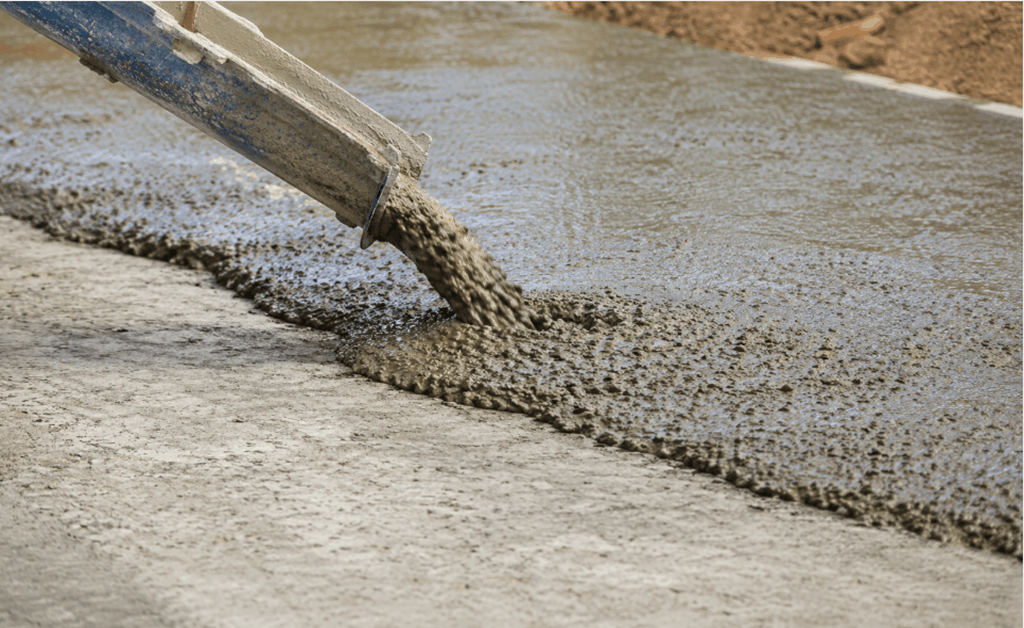
After the bonding agent dries completely, we start pouring the new concrete layer. In this case, we begin from pouring material at the highest elevation point of the slab gradually continuing until completing the whole slab. While pouring, we use a straight screed board to level the layer. We focus closely on edges of the slab making sure that there are no spaces between the new layer and wooden form.
Final Steps to Take
At the final stage, the concrete layer is finished with either a hand trowel or with a broom, depending on the desired degree of slip resistance.
When Is It Not Possible to Pour Over Existing Concrete?
Of course, not all concrete slabs are eligible for having a new layer poured over them. In particular, we never recommend pouring over concrete slabs that have severe structural problems. For instance, if an existing concrete slab has wide and deep cracks, caused by the movements of the base layer, then these cracks will quickly repeat themselves with regard to the new layer, spoiling its appearance.
Also, we do not recommend pouring concrete over such slabs that have been damaged by the growth of tree roots. The latter need to be removed, so only then it would be possible to pour the new layer. Also, if the old concrete slab starts crumbling apart or sinking into the soil due to its instability, then pouring over it will lead only to a temporary improvement.
FAQs
What thickness of new slab is recommended?
In general, the recommended thickness of a new concrete layer is two inches. If we pour less material than this, there would be a big risk that the concrete would start cracking and crumbling rather soon.
Should we use wire mesh in a new concrete layer?
If we pour a concrete layer of two inches for a residential construction, then in most cases we do not need to use any reinforcing material. However, if we need to pour more material or if it concerns a commercial structure, then in order to provide it with maximum strength professionals may use steel wire mesh.
How long can an overlay last?
Under ideal conditions, when everything has been done in the proper way, a well-poured concrete overlay can serve several decades. Its lifetime also depends greatly on the condition of the base slab and the quality of the bonding agent.
Ready to Get Your Concrete Slab Repaired!
Pouring over the existing concrete slab is a good decision if you want to repair it without any serious inconvenience. However, this process requires a lot of attention as well as the professional vision needed for evaluating the condition of an old slab. If you have doubts about pouring or want the result to be flawless, contact Bill’s Custom Concrete & Yard Drainage today!

Rapheal Guinn at Bill’s Custom Concrete & Yard Drainage assists clients with concrete crack repairs, foundation work, and yard drainage solutions such as french drains and excavation.