
Every good build starts underground. Long before concrete gets poured, or the first wall goes up, the dirt has to be right. We pour custom foundations for a living at Bill’s Custom Concrete & Yard Drainage, and if there’s one thing we’ve learned, it’s that excavation sets the tone for everything that follows. Get it wrong, and you’ll feel it for the rest of the project.
Moving dirt sounds simple. It isn’t. It takes planning, a feel for the local ground, and a healthy respect for what’s buried beneath it. We’ve watched plenty of jobs stall out for weeks because someone treated the groundwork like an afterthought. After years of digging, grading, and pouring, we know what a clean excavation actually requires. Here’s how we do it.
Crucial Pre-Excavation Planning and Site Preparation
Before any heavy machinery touches the soil, we plan. Skipping this part is how you end up with severed utility lines, surprise costs, or a subgrade that won’t hold. As an experienced excavation contractor in Oklahoma City, we start with a full site assessment, checking soil quality, moisture levels, and whatever rock might be hiding below.
Conducting Thorough Topographical Site Surveys
A good topographical survey tells us the story of the land before we disturb it. We map the elevations and watch how water naturally wants to move across the property. That matters more than people expect. Where the water goes decides where we grade and how deep we dig.
Done right, this is what keeps your finished foundation dry. Water drains away from the structure instead of collecting against it. If you’ve ever wondered how to excavate a construction site the right way, this is a big part of the answer. We also work hand in hand with engineers to mark every hidden line on the property, so nobody puts a bucket through a gas pipe, a water main, or a buried cable.
Clearing the Work Area for Heavy Machinery
With the surveys in hand, we clear the site. That means pulling out vegetation, hauling off boulders, and clearing whatever debris is sitting in the work zone. We also lay out safe routes for our trucks and excavators to come and go. A clean, well-organized site keeps equipment from sinking into soft ground and keeps the crew out of harm’s way while the work ramps up.
Proven Excavation Techniques and Heavy Equipment
Digging is mostly about matching the right machine to the ground in front of you. Bring something too small, and you’re dragging out the timeline. Bring something too big, and you’re tearing up more of the site than you need to.
Selecting the Right Earthmoving Machinery
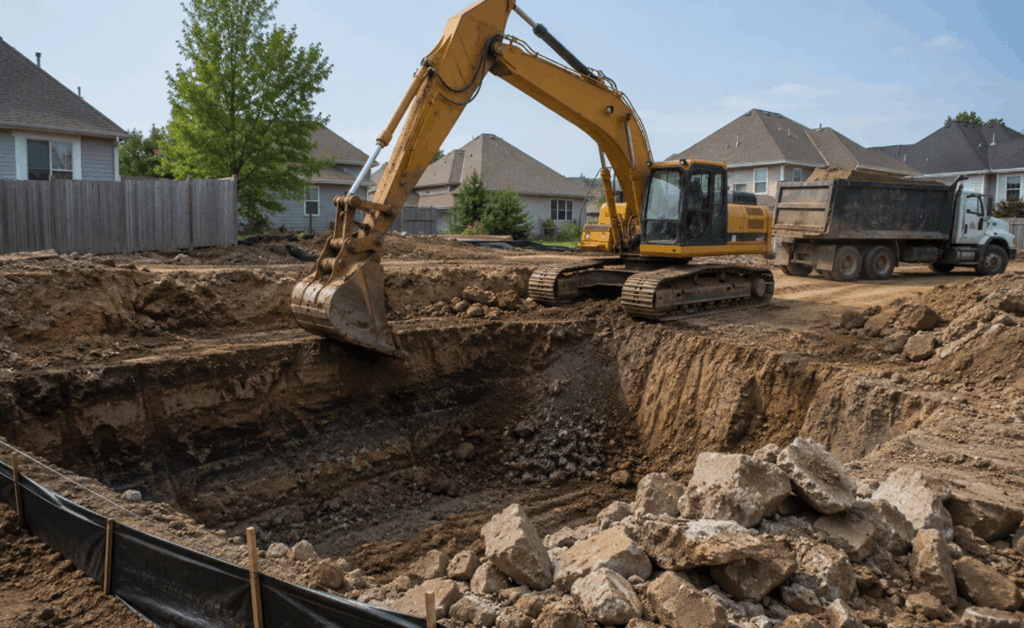
For most residential and commercial jobs, we lean on a mix of crawler excavators and backhoes. The crawler excavators handle the heavy work, digging deep trenches and shifting large volumes of soil in a hurry. Backhoes are the nimble ones, slipping into tight corners the bigger machines can’t reach. Choosing the right equipment is a huge part of any excavation in a construction site, and high-capacity dump trucks keep the spoil moving offsite so that the area stays workable.
Then there’s the ground that fights back. When we hit hard clay or embedded rock, we bring in hydraulic hammers and ripper attachments to break through the stubborn layers underneath.
Implementing Precise Trenching and Grading Techniques
The architectural plans drive our approach here. Trenching lets us run underground utilities and set the exact line for continuous concrete footings. We shore up trench walls as we go, because cave-ins are exactly the kind of thing safety codes exist to prevent, and we follow those codes to the letter.
Once the holes and trenches are dug, grading takes over. This is where the site gets smoothed to the precise elevation our concrete forms need. People underestimate grading, but a level subgrade is honestly the difference between a slab that lasts and one that cracks the first time the ground shifts unevenly beneath it.
FAQs
How Long Does A Typical Construction Excavation Take?
It depends on size, soil, and weather. A standard residential basement might wrap up in three or four days. A large commercial site full of rock could run a few weeks. We give you a real schedule once we’ve completed the initial survey.
What Happens To All The Dirt Removed From The Site?
We don’t just dump it and forget it. Good topsoil usually gets stockpiled onsite for later landscaping or final grading. Excess dirt, rock, or contaminated soil goes straight into the trucks and over to approved local facilities.
Can Severe Weather Affect The Excavation Schedule?
Absolutely. Rain turns the ground to mud, which swallows machines and makes the site dangerous. Frozen ground takes more force to break, which slows everything down. We watch the forecasts closely and adjust the plan when we have to, always with safety first.
Laying the Groundwork for Your Custom Concrete Project
Excavation isn’t just digging a hole. It’s the first real step toward the building you’ve been picturing, and good excavation in building projects is what every durable structure quietly depends on. Solid planning, the right machines, and operators who’ve done this a thousand times mean your site is ready when the heavy phases begin.
Because we handle both the dirt work and the concrete pouring, you get a smooth handoff from raw lot to durable foundation, with no gaps in between. If you’re about to break ground, we’d be glad to take the site prep off your plate. Reach out to our team today at Bill’s and let’s talk through your plans!

Rapheal Guinn at Bill’s Custom Concrete & Yard Drainage assists clients with concrete crack repairs, foundation work, and yard drainage solutions such as french drains and excavation.