

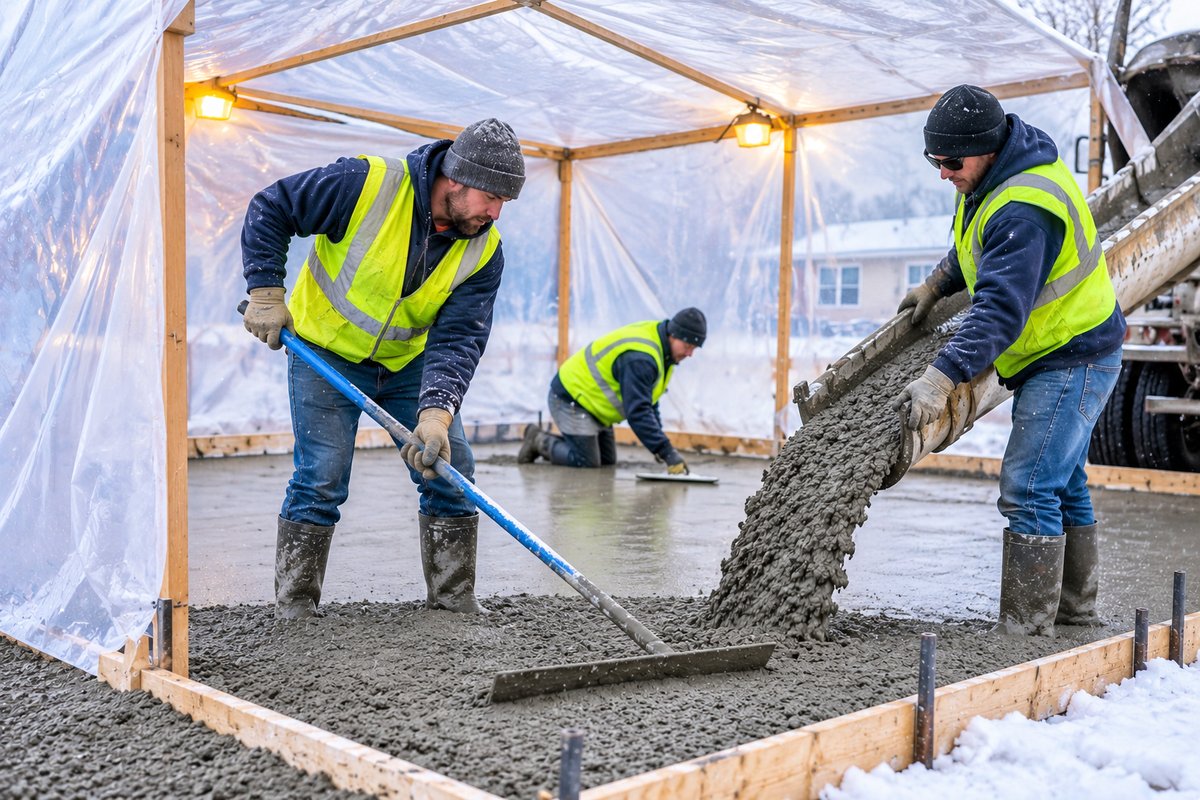
Oklahoma winters don’t come with a schedule. Tuesday is 60 degrees; Thursday you’re scraping ice off your windshield. For anyone thinking about a concrete project during the colder months, that unpredictability raises a fair question: is it even worth attempting?
It is. But scheduling a truck and hoping the weather cooperates isn’t a plan. Pouring concrete in cold weather changes how concrete behaves, and when things go wrong, the damage often doesn’t show up until months down the road. We’ve poured through plenty of Oklahoma winters at Bill’s Custom Concrete & Yard Drainage. We know where the trouble spots are.
Here’s what matters most about cold-weather concrete, why Oklahoma makes it particularly tricky, and how we approach it.
Winter Concrete Pouring: The Professional Way
How Do Freezing Temperatures Affect Concrete Curing and Strength?
Concrete hardens through a process called hydration – a chemical reaction between water and cement that unfolds over time. Temperature has a lot to do with how that goes. When it gets cold enough, the reaction slows down. If the water in the mix actually freezes before the concrete has cured to a sufficient degree, the internal structure takes damage you can’t see and can’t undo. The result is concrete that’s weaker, more likely to crack, and won’t last the way it should.
Cold by itself isn’t really the enemy. Uncontrolled cold is. That’s the whole challenge on a winter job site.
What Are the Risks of Pouring Concrete Below 40°F?
The minimum temperature to pour concrete without serious risk is generally accepted at 40°F – and below that, the margin for error gets thin fast. Concrete placed in those conditions without real precautions can set too slowly, lose long-term strength, or develop surface problems that won’t be obvious until later. A hard freeze in the first 24 hours after a pour is essentially the worst-case scenario – it can wreck the slab entirely, and then you’re tearing it out and starting from scratch.
That doesn’t mean pouring below 40°F is off the table. It means shortcuts aren’t an option. More on that below.
Why Do Timing and Weather Monitoring Matter So Much?
A lot of winter pours go sideways because someone looked at the forecast once and figured they were good. We track hourly conditions – not just the daily high and low. A pour that kicks off under a mild afternoon can be sitting in freezing temps by midnight. Getting concrete down earlier in the day, when temperatures are climbing rather than dropping, gives it more time to cure before the cold moves in. Nothing complicated about it. It just takes paying attention.
Understanding Oklahoma Winter Weather Conditions
What Do Typical Oklahoma Winters Look Like?
Oklahoma winters are genuinely hard to plan around. Daytime temps often land in the 40s and 50s, which is workable. But overnight lows can dip into the 20s – sometimes inside the same 24-hour window. That’s not a steady cold climate. That’s a swing. And the swing is what creates problems.
How Do Freeze-Thaw Cycles Impact Concrete Durability Here?
When temperatures hang around the freezing mark and keep crossing back and forth over it, concrete takes real stress. Water finds its way into small gaps, freezes, expands, then thaws and shifts again. Repeat that enough times over a winter, and you get surface scaling, cracking, a slab aging faster than it should. The damage is preventable – but only if the concrete was properly looked after while it was still curing. This is especially relevant for concrete driveways Oklahoma City homeowners rely on year-round, where freeze-thaw exposure is a real seasonal factor.
Why Does Oklahoma’s Climate Variability Make Planning So Important?
One mild week doesn’t mean much. Oklahoma has a habit of following a decent stretch with a sudden hard freeze, and if you’ve already committed to a pour date, that puts you in a rough spot. We keep flexibility built into our winter scheduling and watch extended forecasts – not out of excessive caution, but because getting caught flat-footed is expensive.
So, Can You Pour Concrete in Winter in Oklahoma?
Can you pour concrete in winter in Oklahoma? Yes. Concrete absolutely gets poured during Oklahoma winters. It just has to be done right, and that means actual precautions – not optimism.
What Best Practices Do We Follow for Winter Concrete Pouring?
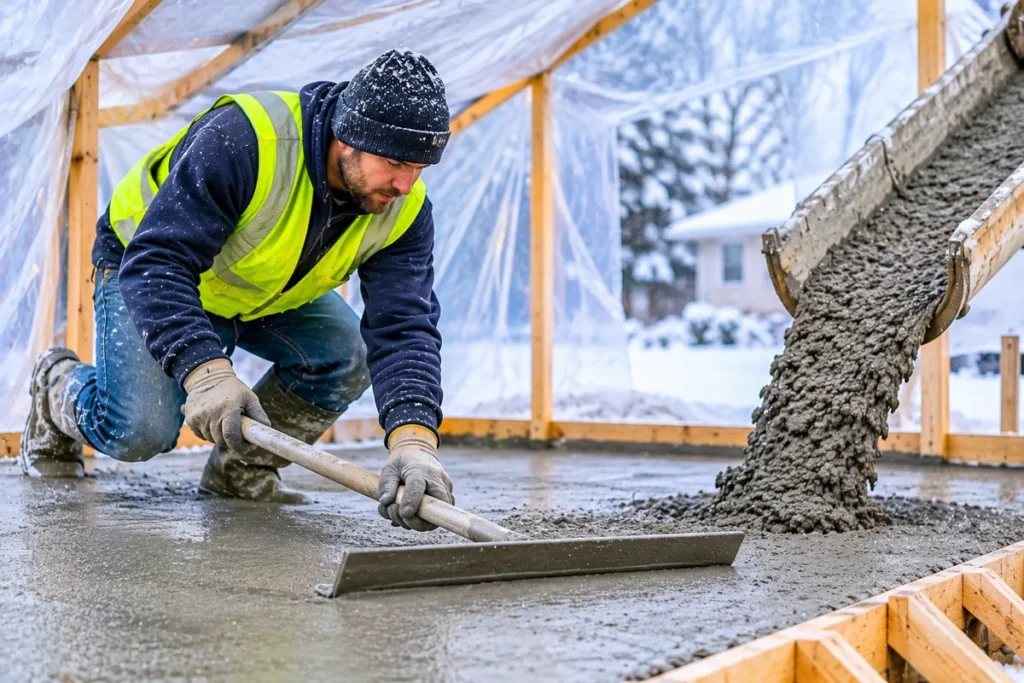
Depending on conditions, we use a few different tools. Insulated blankets and heated enclosures hold the slab at a stable temperature after the pour. Accelerated-curing admixtures speed up hydration so the concrete hits adequate strength before it’s exposed to the cold on its own. Sometimes the mix design itself gets adjusted – the water-to-cement ratio, for instance – to get better performance in low temperatures. After the pour, we stay on top of the slab for the first several days and catch any issues early.
None of this is complicated. It’s just what a winter pour takes.
When Should Pouring Be Avoided Entirely?
Sometimes waiting is the smarter move. A sustained cold snap with temperatures well below freezing can be tough to work around even with precautions in place. Precipitation is a bigger red flag. Pouring concrete ahead of snow, sleet, or freezing rain rarely ends well – moisture interfering with the curing process can compromise the whole slab. When conditions line up that way, we’d rather reschedule than hand over work we’re not confident in.
Frequently Asked Questions
Does winter concrete cost more than a standard pour?
Usually, yes. The extra materials – insulated blankets, heated enclosures, admixtures – and the added labor involved push the cost up. Not dramatically, but it’s there. Think of it as protecting the investment you’re already committed to.
How long does winter concrete take to cure?
Slower hydration means the process can take longer. With accelerants and proper temperature management, though, concrete can still reach solid strength within a window that’s not too far off from a warm-weather pour. It depends on conditions, but it’s rarely as drawn out as people expect.
Can I pour concrete myself during an Oklahoma winter?
We’d steer you away from that. Winter pours involve temperature monitoring, mix adjustments, and protective measures that are hard to get right without experience. When a DIY winter pour goes wrong, the fix usually costs more than hiring professionals from the start would have.
What is the minimum temperature to pour concrete?
The minimum temperature to pour concrete without serious risk is generally accepted at 40°F. Pouring below that is still possible, but only with real precautions such as insulated blankets, heated enclosures, and accelerated-curing admixtures.
When should a winter concrete pour be postponed?
Postpone the pour during a sustained cold snap with temperatures well below freezing, or when snow, sleet, or freezing rain is in the forecast. Moisture interfering with the curing process can compromise the whole slab.
Ready to Plan Your Winter Concrete Project?
Cold weather doesn’t have to push your project to spring. With solid planning and the right techniques, durable results are genuinely achievable in the middle of an Oklahoma winter. If you’ve got a concrete or drainage project in the works and you’re not sure how the timing fits together, reach out. We’re glad to take a look at your site and walk through your options.

Rapheal Guinn at Bill’s Custom Concrete & Yard Drainage assists clients with concrete crack repairs, foundation work, and yard drainage solutions such as french drains and excavation.