

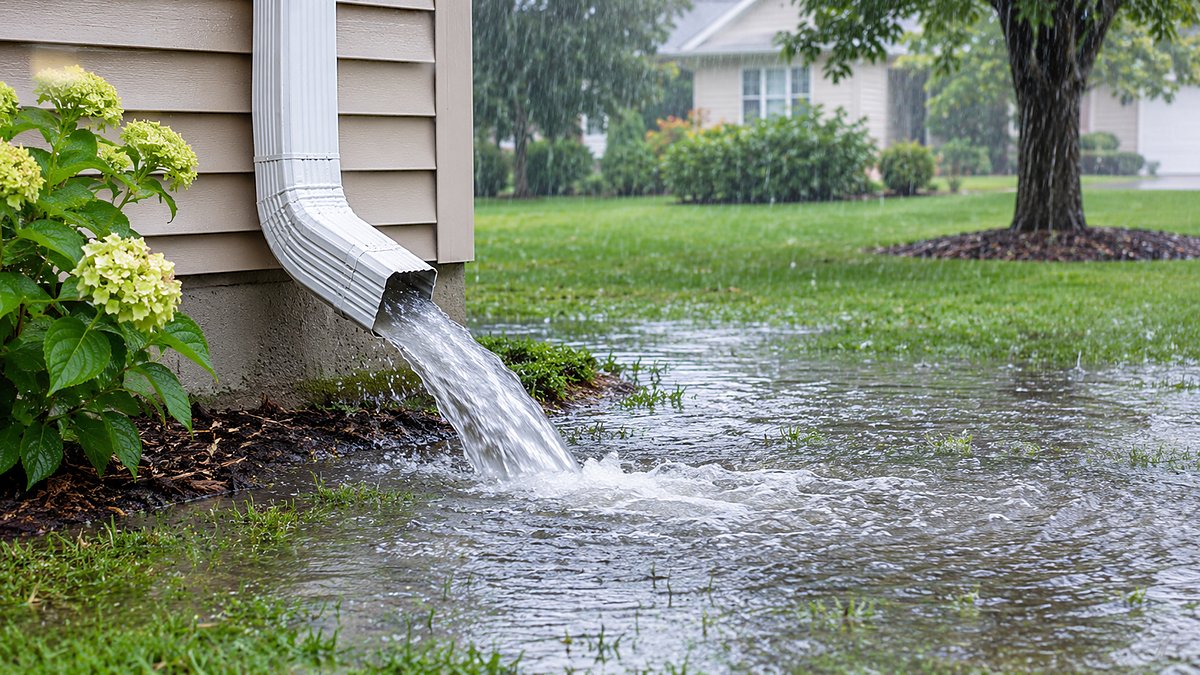
Step outside after a heavy Oklahoma storm and you might find your yard halfway underwater. It’s a pretty common call we get from homeowners around the OKC metro. And while there are a few things that can cause it, the problem traces back to the downspouts more often than you’d expect. It doesn’t look like a big deal at first. But leave it alone long enough, and it starts affecting your foundation, your landscaping, and eventually what your property is worth.
Here’s what’s actually going on, what we see most often around Oklahoma City at Bill’s, and how to figure out what your yard actually needs.
Why Downspouts Cause Yard Flooding
Improper Placement Sends Water Toward Your Foundation
A lot of the drainage calls we go on come down to one thing: the downspout is dumping water too close to the house. A foot or two from the foundation, and there’s really nowhere for that water to go. It pools up, works into the soil, and starts making its way toward the crawl space or basement. It’s one of the most common issues of yard drainage Oklahoma City homeowners deal with, and what makes it tricky is that it usually goes unnoticed for a while – the pooling only becomes obvious when you get a real soaker.
Heavy Rainfall Overwhelms Undersized Systems
Oklahoma storms don’t ease you in. Several inches in a short window is not unusual, and when that happens, a lot of standard gutter and downspout setups just can’t keep up. If the system was sized for a smaller roof or a lighter rain load, it’s going to fall behind fast. We’ve seen systems that held up fine for years suddenly start failing – usually after the landscaping around the house matures or the grading nearby shifts a little.
Clay Soil Makes Absorption Difficult
OKC has a lot of heavy clay soil, and it doesn’t behave like the sandy or loamy stuff you find in other parts of the country. Clay compacts hard and takes in water slowly. So instead of soaking down into the ground, water just sits on top or rolls toward whatever low point it can find. This is a big part of why downspout drainage solutions designed for other regions don’t always work here. You have to build around how slowly that clay actually moves water.
Common Drainage Problems in Oklahoma City
Standing Water Creates a Breeding Ground for Mosquitoes
If water is hanging around your yard for more than a day or two, mosquitoes are going to find it. We’ve worked with families who’d been battling mosquitoes all summer, and when we looked at the yard, it came down to a low spot near the downspout that just never drained. Fix the drainage, and the mosquito problem usually follows.
Erosion Damages Landscaping and Hardscaping
Water doesn’t just sit there – it moves, and it takes things with it. Soil, mulch, gravel, whatever’s in the way. Over time, that movement starts eating at patios, walkways, and retaining walls. We’ve seen a single misdirected downspout do thousands of dollars of damage to a backyard patio over just a few seasons. It adds up quietly.
Foundation Settling and Moisture Intrusion
This one matters most to us. When water pools consistently near a foundation, the soil underneath starts expanding and contracting as it wets and dries out. In clay-heavy soil, that cycle hits harder than most people realize. It leads to foundation settling, cracked slabs, and moisture getting into basements and crawl spaces. If there’s one reason to deal with downspout drainage sooner rather than later, this is it.
Choosing the Right Solution for Your Property
Start by Assessing Your Yard’s Current Drainage Patterns
Before we suggest anything, we look at how water actually moves across the property when it rains. Where it pools, where it runs, and which downspouts are dumping the most volume. That tells us whether we’re dealing with something a simple extension can handle, or whether the yard needs a French drain, a dry creek bed, or a full underground downspout drain system. There’s no one-size answer.
Factor in Soil Type and Local Rainfall Patterns
We build every system around OKC’s clay soil – slow drainage is just the baseline here. We also think about how hard the rain typically hits, because a system that handles a mild spring drizzle isn’t going to do much in a real storm. Getting the sizing and design right for local conditions is the difference between a fix that lasts and one you’re revisiting in two years.
Weigh the Budget Considerations for Each Option
The range is wide. Downspout extensions and splash blocks are cheap and fast. French drains, catch basins, and underground systems cost more upfront but actually get at the problem. We go through the trade-offs with clients so they can land on something that fits what they’re dealing with and what they want to spend.
Decide Between a Professional Assessment and a DIY Fix
If water is pooling near one downspout and it’s not a recurring thing, a DIY extension or some minor regrading might be all you need. But if the standing water keeps coming back, if there’s visible erosion, or if anything looks off with the foundation – get someone out to look at it. There are grading issues and soil conditions that don’t show up until you know what you’re looking for, and a quick patch on top of an underlying problem doesn’t stay patched for long.
FAQs
How much does a yard drainage system cost in Oklahoma City?
It depends on what the yard actually needs. A basic downspout extension is minimal. A French drain or full underground system is a bigger investment. We quote based on what we see at the property, not a flat number.
Can I fix downspout flooding myself, or do I need a professional?
For something simple – a downspout emptying too close to the house – a basic extension often does the job. If you’re seeing recurring flooding, erosion, or anything that looks like foundation movement, it’s worth having someone assess it properly before the problem compounds.
How long does it take to install a drainage solution?
A downspout extension or splash block is usually a single visit. French drains and underground piping systems run longer – typically one to three days, depending on the yard size and how involved the layout is.
Protect Your Property Before the Next Storm
Downspout flooding and yard issues don’t sort themselves out, and in Oklahoma’s clay soil, small drainage issues have a way of becoming bigger ones without much warning. If water’s been collecting in your yard after rain, we’re happy to walk the property, see how things are draining, and talk through what makes sense for your situation. Get in touch with Bill’s Custom Concrete to set up an assessment before the next storm shows up.

Rapheal Guinn at Bill’s Custom Concrete & Yard Drainage assists clients with concrete crack repairs, foundation work, and yard drainage solutions such as french drains and excavation.